
AI Played World of Warcraft Without Ever Looking at the Screen
OpenAI's GPT-6 Astra cleared World of Warcraft's orc starting zone in 40 minutes without dying once, and without seeing a single frame. The more interesting part is how it saw the world, and how much of its own tooling it built.

When a human plays World of Warcraft, they look at the screen: green hills, quest givers with yellow exclamation marks above their heads, boars charging toward them.
GPT-6 Astra saw none of that.
To the model, the game was little more than data packets moving back and forth between the server and the client.
Using that data, Astra started an orc character at level one, completed every quest in the Valley of Trials, and ended the run in Sen'jin Village.
Total time: 40 minutes.
Deaths: zero.
How Does a Player Without Eyes Play?
The experiment was conducted by the developer of an open-source project called agent-wow.

agent-wow is a World of Warcraft client designed for AI agents. But interestingly, it is almost an empty shell. It does not define basic mechanics such as movement, combat, or in-game interaction.
It can communicate with the game's network protocol and provides a module system that allows an agent to add its own tools.
In other words, Astra had to build much of what it needed to actually play the game.
And it did.
According to the developer, with a single prompt given to Codex, the model built the following on its own:
- Its eyes: A module that captures 28 different types of messages coming from the server and keeps them in memory. A Python script continuously reads those messages to construct the model's picture of the world, while actions are sent back to the server as messages.
- Its map: A helper tool written in C++ that uses the game's own navigation files to calculate routes between two points.
- Its quest knowledge: Information about quest givers, turn-in locations, and monster spawn points pulled directly from the server's own database files.
The developer had expected a higher-level approach and was surprised that the model could work this far down the stack, directly at the protocol layer.
Astra also planned like a player.
It completed quest chains in order, sold useless items, equipped better gear, trained its abilities before entering the zone's final cave, and picked up two quests in the same cave so it could complete both in a single trip.
In some areas, it even took advantage of possible gaps in the map's collision data and walked through walls.
But Does This Really Count as Playing Blind?
The headline is fascinating, but one detail matters: this experiment did not take place on Blizzard's official servers.
Astra played on a private server built with AzerothCore, an open-source server implementation running the final version of World of Warcraft's Wrath of the Lich King expansion.
That distinction matters because the model obtained its quest information from the server's own database.
The developer compares this to a human player spending hours researching quests on a fan site such as Wowhead.
But there is an important difference.
A fan site contains information collected and organized by players.
The server database contains the raw data the game itself runs on.
An ordinary player on Blizzard's official servers does not have access to those files.
So Astra did not look at the screen.
But it did look at something an ordinary player cannot see: the game's sourcebook.
There is another caveat worth separating from the headline.
This was not a controlled benchmark. It was a single run published by the developer.
So the 40-minute completion time and zero-death result should not be interpreted as performance Astra would necessarily reproduce every time.
Bots Already Existed
Bots — automated programs that play in place of humans — have been a problem in World of Warcraft for almost as long as the game itself.

For years, programs have existed that read network traffic, use their own pathfinding algorithms, and complete quests automatically.
That exact objection also appeared in reactions to the experiment:
Bots have been doing this for decades.
The criticism is fair.
But it misses one important difference.
Older bots were written by humans.
Reverse-engineering the network protocol, building the navigation system, and organizing quest data were specialist tasks that could take months.
In this experiment, the AI wrote all of that itself from a single prompt.
According to the developer, pathfinding was always one of the hardest parts of traditional heuristic-based bots.
The routes Astra found, meanwhile, were described as "optimal."
We are seeing a familiar pattern again.
AI is not necessarily inventing something new.
It is dramatically reducing the cost and expertise required to do something that already existed.
Writing a bot is not new.
What is new is a bot that can write the bot.
What Comes Next?
This was not Astra's first test inside a video game.

Shortly after the model launched last month, it completed Portal in an experiment that lasted roughly 24 hours.
But that setup was very different: the game was paused while the model was thinking, and Astra was given screenshots along with the player character's position and camera angle.
The World of Warcraft experiment used no visual input at all and covered only the starting zone.
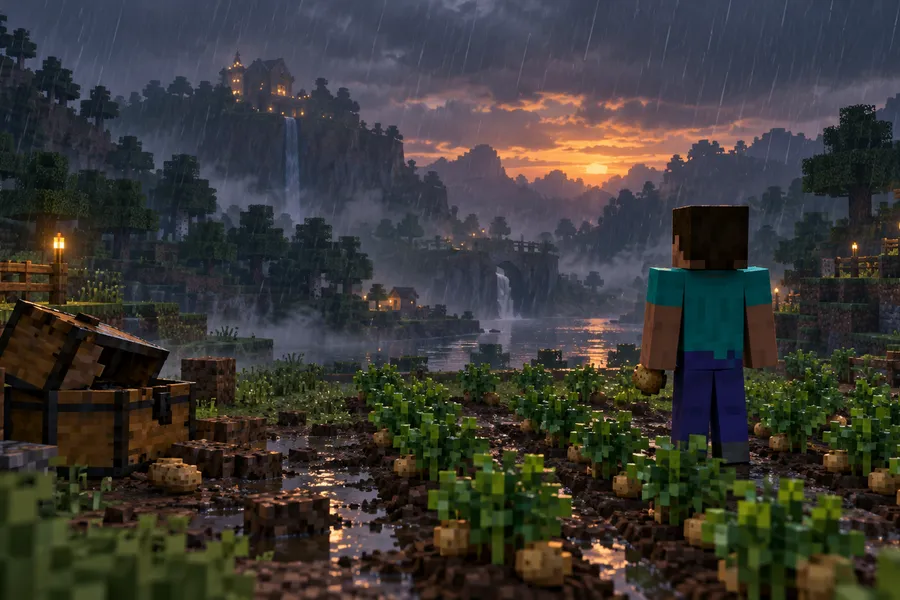
In a separate 141-hour Minecraft experiment, Astra also made headlines after a Creeper destroyed its chest and bed, after which the model spent hours farming potatoes.
The agent-wow developer has much more ambitious goals.
The next step is to see whether a single agent can reach the maximum level of 80 without any assistance.
The ultimate goal is to fill an entire server with AI agents and see whether they can work together to clear Icecrown Citadel — one of the game's hardest raids — on Heroic difficulty.
A raid that once required 25 players to gather together and spend hours coordinating over voice chat could one day be completed by a community of AI agents that never look at the screen and communicate with one another through packets.
Who gets excited when the loot drops at the end is another question.