
He Broke His Own Mod After 10 Years: The Target Was AI-Assisted Copies
The creator of SFO: Grimhammer III, one of Total War: Warhammer III's most popular mods, deliberately broke it to stop unauthorized AI-assisted copies. The crisis lasted only days, but the question it raised will not go away.
SFO: Grimhammer III is one of the most ambitious mods ever made for Total War: Warhammer III.
The "total overhaul" reworks almost every part of the game, from the campaign map to battle balance. According to its creator, Venris, it represents nearly a decade of work.
And it has always been free.
The mod has more than 300,000 active subscribers on the Steam Workshop, with over 1,400 other Workshop items depending on it.
This week, Venris deliberately broke it.
What Happened After the Expansion?
The story begins with Lords of the End Times, released on September 24 and described by Creative Assembly as the largest expansion in the series' ten-year history.
The expansion brought changes extensive enough that many major mods stopped working with version 9.0 of the game.
SFO was one of them.
The team began working on an update to make the mod compatible with the new version.
But while players were waiting, something else started happening on the Steam Workshop.
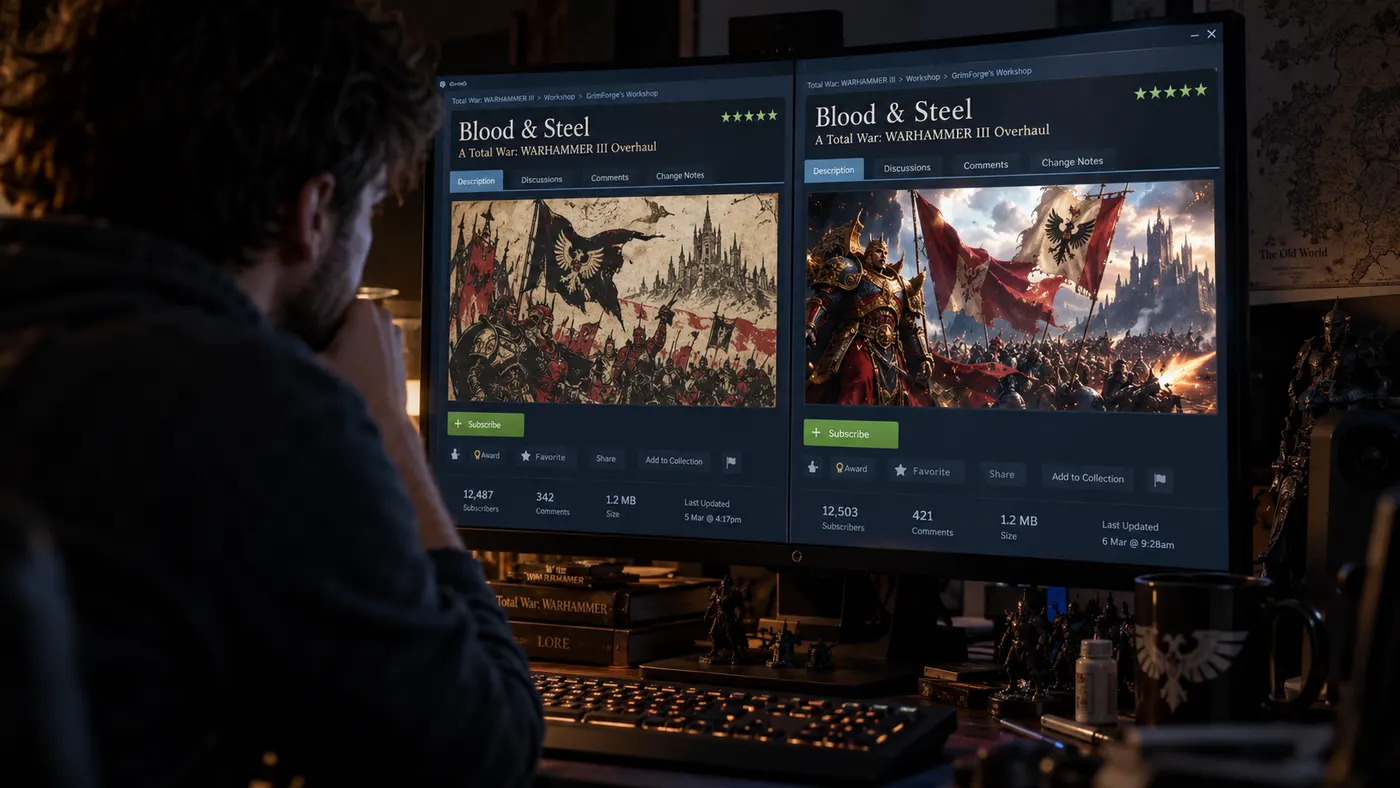
According to Venris, some users began publishing unauthorized reuploads and submods intended to make SFO work with the new version, using AI as part of the process.
PC Gamer also reported that a significant number of these Workshop uploads used AI-generated cover art.
"I Deliberately Corrupted It"
Venris responded in a post on his Patreon page.
He said that as unauthorized uploads increased — particularly those involving AI — he intentionally corrupted the mod so that those versions would no longer work with it.
He added that if the situation continued to escalate, he would make SFO completely private, effectively removing public access.
The rest of the message was more personal.
Venris described the mod as the product of nearly ten years of love for the community and the fantasy setting, and said he did not want his work to be used without permission, particularly for AI-related purposes.
He ended with a simple message:
"Support modders, not AI."
He also stressed that as long as SFO continued to exist, its mods would remain free for everyone.
The sabotage did not last long.
After drawing attention to the issue, Venris restored version 8.1.1 of the mod, which still works with the previous version of the game, and thanked both the players who supported him and those who criticized his decision.
Work on the new version continues.
A Debate With Two Sides
What makes the story interesting is that not everyone agrees.
For Venris' supporters, the issue is straightforward.
A project built from years of unpaid work is being taken without the creator's permission, modified with the help of AI and republished.
The quality of those copies is also uncertain. If something breaks, players may still end up blaming or contacting the creator of the original mod.
Some critics, however, point to a different side of modding culture.
Submods built on top of SFO have always existed, and the community has lived with them for years.
From this perspective, someone trying to keep a major mod working for their own use is not necessarily a threat.
And by deliberately breaking the mod, Venris also punished the loyal players who had nothing to do with the unauthorized copies.
Both sides have a point.
And that ambiguity comes from the unwritten rules that have governed modding communities for years.
The Unwritten Rules
Modding communities have long operated under a simple convention:
If you use someone else's work, you ask for permission and give credit.
Often, this is less a formal license than a matter of etiquette.
But it worked, partly because adapting a major mod to a new version of a game required significant knowledge and effort.
Someone willing to do that much work was usually also familiar with the rules and expectations of the community.
AI has not fundamentally changed that balance.
It has changed the scale.
Repackaging someone else's work is nothing new, but the cost and expertise required to do it are falling quickly.
That means far more people can now enter the process without knowing — or caring about — the unwritten rules.
The problem is no longer just a single copy.
It is the number of copies and the speed at which they can appear.
We are seeing the same pattern elsewhere on the internet.
AI-generated material can flood systems built on human labor far faster than before, from news sites to open-source projects and now game mods.
The cost of producing the content falls.
The cost of determining whether it is any good — and tracing whose work it came from — does not.
That is why Venris' decision can be read as both a protest and an admission.
For the creator of something distributed for free, one of the strongest tools left for controlling how that work is used may simply be to shut it down or break it.
This time, the move at least got attention.
The mod returned, and the debate grew.
But when a modder feels that sabotaging ten years of his own work is a reasonable option, it also shows how little consensus there is over how modding communities are supposed to survive in the age of AI.