
The $399 Microduck Robot Duck Is Nearing 20,000 Preorders: Why Is It So Popular?
The Microduck robot duck Jensen Huang played with onstage has passed 20,000 preorders. How it learns to walk in simulation, how owners can teach it new moves, and whether you can order one from Turkey.
What Is Microduck?
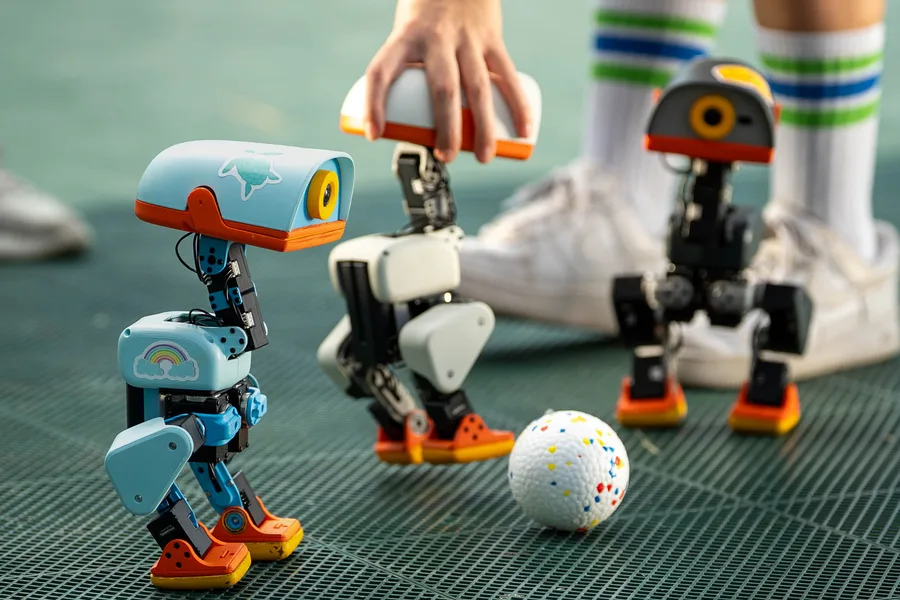
Microduck is a small, two-legged walking robot developed by French robotics company Pollen Robotics. Hugging Face, the AI platform, acquired Pollen Robotics in 2025. On September 2, 2026, NVIDIA signed an agreement to acquire Hugging Face. According to NVIDIA's official filing, the deal is expected to close in the first half of 2027, subject to the necessary approvals. Microduck is Pollen Robotics' second consumer-focused robot, following its earlier desktop robot, Reachy Mini.
According to Pollen Robotics' specifications, Microduck stands about 25 centimeters tall and weighs roughly 800 grams. It has 15 motors, a camera, a LiDAR sensor, and two inertial measurement units (IMUs). Its articulated beak can pick up small objects. Battery life is approximately one hour—an important detail for anyone considering spending $399 on one.
 Image: Pollen Robotics
The $399 introductory price does not include taxes or shipping. Preorders opened on August 27. Interest surged after NVIDIA's GTC conference in Berlin on October 21, when a video of Jensen Huang interacting with a flock of Microducks onstage went viral. Hugging Face CEO Clem Delangue said the following day that total preorders would probably pass 20,000 soon; TechCrunch subsequently reported that the milestone had been reached. In other words, the 20,000 figure refers to all preorders collected since August, not orders placed in a single day after the demonstration.
How Does a Robot Learn to Walk?
One of the most interesting things about Microduck is how it learns to walk.
Walking on two legs is surprisingly difficult for a robot. It needs to maintain its balance with every step, adapt to uneven ground, avoid falling when pushed, and recover when it does fall. Traditional control methods can also make robots walk, but developing a gait that adapts to changing conditions remains a considerable challenge.
Microduck tackles this problem by learning through trial and error in a computer simulation. This is called reinforcement learning: a virtual duck takes a step, receives a penalty for falling or a reward for making progress, and gradually learns an effective way to move. NVIDIA's open-source Isaac Lab software can run thousands of simulated ducks in parallel on GPUs. By training so many virtual robots at once, researchers can greatly accelerate a trial-and-error process that would take much longer in the physical world.
 Image: Pollen Robotics
There is a catch, though: a simulation is not the real world. Real motors have friction and delays, and tiny gaps in their gears. A robot's power output can also change as its battery drains. A duck that walks perfectly in simulation might stumble on its very first step in reality.
To address this, researchers deliberately introduce imperfections into the simulation. According to NVIDIA's technical explanation, each virtual duck is exposed to random variations in weight, ground friction, motor delay, battery voltage, and gear backlash. The simulated robots are also pushed around. This technique is known as domain randomization. The goal is to prepare the robot for many different real-world conditions instead of a single ideal environment. Transferring behaviors learned in simulation to a physical robot is known as sim-to-real transfer. In NVIDIA's footage, a real Microduck trained using this approach gets back on its feet and continues walking after being knocked over.
The Bigger Innovation: Owners Can Teach It New Tricks
Microduck comes with basic movements such as walking, sitting, and standing up, and a game controller is included in the box. It is not yet clear whether the voice-command interactions demonstrated onstage will be available in the same form during normal use.
 Image: Pollen Robotics
According to Pollen Robotics, owners can train Microduck to perform new movements and share them with the community. The robot's software is open source, although its mechanical design and electronic hardware files are not. Isaac Lab includes a ready-made Microduck training environment: users can train their own walking policies in simulation, export the results as a file, and deploy them to a real robot. These trained “brains” can be shared on Hugging Face. On a platform called Microduck Arena, users can also compare the walking policies they have trained against one another in shared challenges.
It is a notable step at a time when much of the public's experience with AI still takes place on a screen. Training a robot independently has traditionally called for expensive equipment and access to research labs. Microduck aims to bring an experience once largely confined to research environments into homes through a $399 programmable device.
What You Should Know Before Ordering
If Microduck has caught your attention, there are a few things worth keeping in mind:
- It is not officially available in Turkey. Turkey is not among the countries listed for direct orders through Pollen Robotics' official store at launch. That could change, but ordering directly from Turkey does not currently appear to be an option.
- Delivery may take longer than expected. The first deliveries are targeted for December 2026, before Christmas. However, Christmas delivery is no longer guaranteed for new orders, and estimated waiting times of four to six months have been mentioned.
- Training requires a capable computer or cloud resources. Microduck comes with its basic movements ready to use. If you want to train new behaviors locally with Isaac Lab, you will need a Linux computer with a supported NVIDIA GPU. Pollen Robotics also offers a cloud-training option through Hugging Face Jobs.
- This is a first-generation product. There are not yet long-term reviews from everyday owners.
More Than Just an Adorable Toy?
The first reason Microduck is attracting so much attention is obvious: it is genuinely cute. But its greater significance lies elsewhere. As AI moves beyond screens and into the physical world, Microduck makes it possible for more people to see—and experiment with—what it takes to teach a machine to move.
Watching a robot take its first steps can feel a little like watching a child learn to walk: it stumbles, falls, and gets back up. That is Microduck's real promise. The person teaching it those first steps might not be working in a laboratory at all. They could be sitting in their living room.