

.agent and .agi Could Join .com: The Internet Is Expanding Again After 14 Years
After 14 years, ICANN has revealed new domain extension applications: 1,615 in total, with .agent the most contested. OpenAI, Google, Meta and Anthropic are all on the list. When will these extensions be usable, and do they really matter?
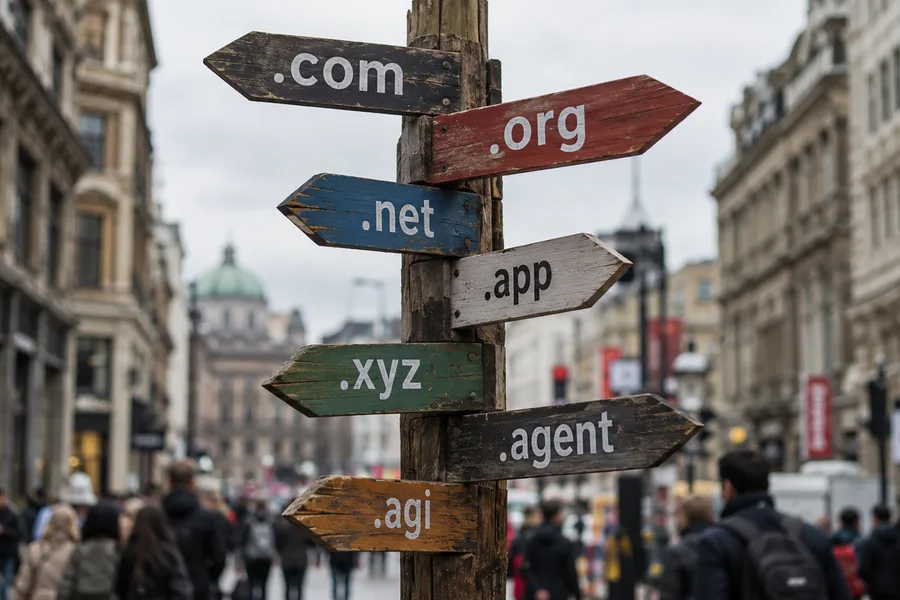
What's happening?
ICANN, the nonprofit organization that coordinates the internet's domain name system, revealed the new top-level domain applications on October 7. Applications were collected between April 30 and August 12, and the results look like this:

- 1,615 applications from 481 different applicants
- 333 are brand applications, where companies want to use their own names as domain extensions
- 21 applications are for internationalized domain names (IDNs), supporting writing systems such as Arabic and Chinese
- By region, the largest number of applications came from North America (864) and Europe (506); Africa submitted only 16, while Latin America and the Caribbean submitted 11
This is the first round since the major expansion in 2012. That round received 1,930 applications and has since added more than 1,200 new extensions to the internet. Many of the extensions we use today, such as ".xyz", ".shop" and ".online", came from that round. Turkey has examples too: ".istanbul" and ".ist" were secured in the same round and launched in 2016.
AI companies are lining up
The most striking part of this round is that the application list looks almost like a presentation from an AI company.

".agent" became the most sought-after extension. The name evokes AI agents — artificial intelligence programs that can act on behalf of users — and it received 13 applications. Applicants include OpenAI, Meta and Google's domain registry company. In 2012, ".app" held the same distinction; the contrast between the two rounds shows how the internet's focus has shifted from apps to AI agents.
Other AI-related extensions are crowded too: ".agi", short for artificial general intelligence, received 7 applications, while ".asi", referring to artificial superintelligence, received 5. The list also includes technical terms such as ".prompt", ".llm" and ".mcp" — words that few people outside the field would have recognized just a few years ago.
Companies also want their own products as extensions:
- Google's domain registry company filed 39 applications, including AI-related extensions such as ".gemini", ".gemma" and ".deepmind".
- OpenAI filed 15 applications: brand names such as ".openai", ".chatgpt", ".codex" and ".gpt", alongside broader industry terms such as ".agent", ".agi" and ".model".
- Meta filed 18 applications, including ".facebook", ".instagram", ".threads", ".whatsapp" and ".meta".
- Anthropic applied for ".anthropic" and ".claude".
For companies whose main business is operating domain registries, the numbers are even larger; some major registry operators submitted hundreds of applications on their own.
These applications are not cheap. Each extension carries a $227,000 evaluation fee, and some additional evaluations may cost extra.
Who gets ".agent"?
When multiple applicants want the same extension, their applications form what ICANN calls a contention set. The rules for resolving those disputes are stricter in the 2026 round: applicants are not allowed to settle the competition through private auctions, agreements to withdraw in exchange for payment, or other private arrangements.

If there is an eligible community application, a process known as Community Priority Evaluation can come into play first. If the contention still remains, the winner is determined through an auction organized by ICANN.
These auctions do not necessarily end at small figures. One of the most striking examples from the 2012 round was ".app": Google's domain registry company won the extension in 2015 for just over $25 million.
That makes ".agent" one of the most interesting contests in this round. On one side are some of the world's largest technology companies and major domain registry operators; on the other is an applicant seeking to run the extension with a community-based model.
When will we be able to use these extensions?
Not yet. For now, all we have are applications; none of these extensions can be purchased today.

The process will unfold in stages. Applicants that submitted an eligible replacement string with their original application can switch to that alternative under certain conditions until October 21. ICANN will then publish the final list of strings moving forward on November 17, followed by periods for objections and public comments. A draw to determine the order in which applications are processed is planned for the first half of 2027. Because successful applications must still pass evaluation, contracting and technical delegation stages, the first new extensions may not become available for actual use until later in 2027 at the earliest.
Not every extension will be open to everyone. Most brand extensions, such as ".chatgpt" or ".instagram", are expected to be used within the companies' own ecosystems rather than sold as domain names to the general public. For generic extensions such as ".agent", who gets to sell domains — and under what rules — will depend on which applicant ultimately wins.
Does it really matter?
It's a fair question, because the experience of the 2012 round was mixed. More than 1,200 new extensions were added to the internet, yet ".com" remains by far the most widely used. Some newer extensions found a lasting place, while many others ended up lightly used or largely empty.
New extensions can also create security debates. In 2023, Google's launch of ".zip" and ".mov" drew criticism because those endings resemble file extensions and could potentially be abused in phishing or other scams. A domain like ".agent" may raise similar questions: as AI agents become more common, verifying whether an agent really belongs to the company it claims to represent could become increasingly important.
But perhaps the real value of this application list lies somewhere else: it is a snapshot of which words the internet currently considers important. In 2012, companies were competing for the vocabulary of the app era. In 2026, they are competing for the vocabulary of artificial intelligence. It will take years to see how many of these extensions actually gain widespread use, but the words companies are fighting over already offer a useful clue about where the internet is heading.