

The AI Content Empire Collapsed: The Real Problem Wasn't AI, It Was Fake Authors
Brown Brothers Media said it had built a network generating more than 50 million page views a month by filling old, trusted publications with AI-generated content. Two weeks after an investigation, much of the network stopped publishing. The most revealing part was not the machines writing the articles, but the lie about who was writing them.

On paper, the business model was almost ingenious.
Buy aging publications that had lost much of their readership but still carried weight in search engines. Strip down the staff. Fill the sites with AI-generated articles. Let the domain history, search visibility and authority accumulated over years help the new content spread far faster than it otherwise could.
Brown Brothers Media’s portfolio included names such as VegOut, Silicon Canals and Space Daily, a publication with more than three decades of history.
The company claimed that its network generated more than 50 million page views a month.
And that figure was not simply corporate boasting. Similarweb estimated that the network had averaged around 64.7 million visits per month over the previous year.
Much of that traffic came from Google. The company itself also credited its growth to organic reach through Google Search and Discover.
The Fake NASA Engineer

The road to the collapse became visible on September 17, when U.S. technology publication Futurism published an investigation into the network.
What it found went far beyond the use of artificial intelligence.
The sites were publishing articles under the names of people who did not exist.
The investigation identified more than 50 fabricated author profiles across the network. Among them were fake experts such as “Dr. Katherine Chen,” presented as a former NASA JPL engineer, and “Dr. James Whitfield,” described as a researcher at the European Space Agency.
These profiles came with invented biographies, invented areas of expertise and, in many cases, AI-generated headshots.
In some cases, the name of a real person was placed beneath articles that had been generated entirely by AI.
The same supposed writer could appear to be covering astrophysics on one site, vegan nutrition on another and beluga whales in Canada on a third.
The articles themselves presented another problem.
The same stories were republished again and again in slightly altered versions. Original reporting from real journalists was rewritten and reused without proper attribution. Headlines were long, emotional and engineered for clicks.
A Collapse in Two Weeks

When Futurism began asking questions, the company’s first response was not to explain itself.
Content started disappearing.
Fake author profiles vanished. Large parts of some publications’ archives were removed.
Then came the collapse in Google visibility.
After the investigation, sites across the network became extremely difficult to find in search results and nearly disappeared from Google News.
For one site, VegOut, the number of pages indexed by Google reportedly dropped to roughly ten — all of them static pages.
In some cases, even searching for the publications by name no longer surfaced the sites.
For a business model heavily dependent on Google traffic, that was effectively the equivalent of shutting off the tap.
Much of the network stopped publishing shortly afterward.
As of September 30, the company’s main website remained largely unchanged.
Its publications, however, had gone quiet.
Where Does Google Draw the Line?
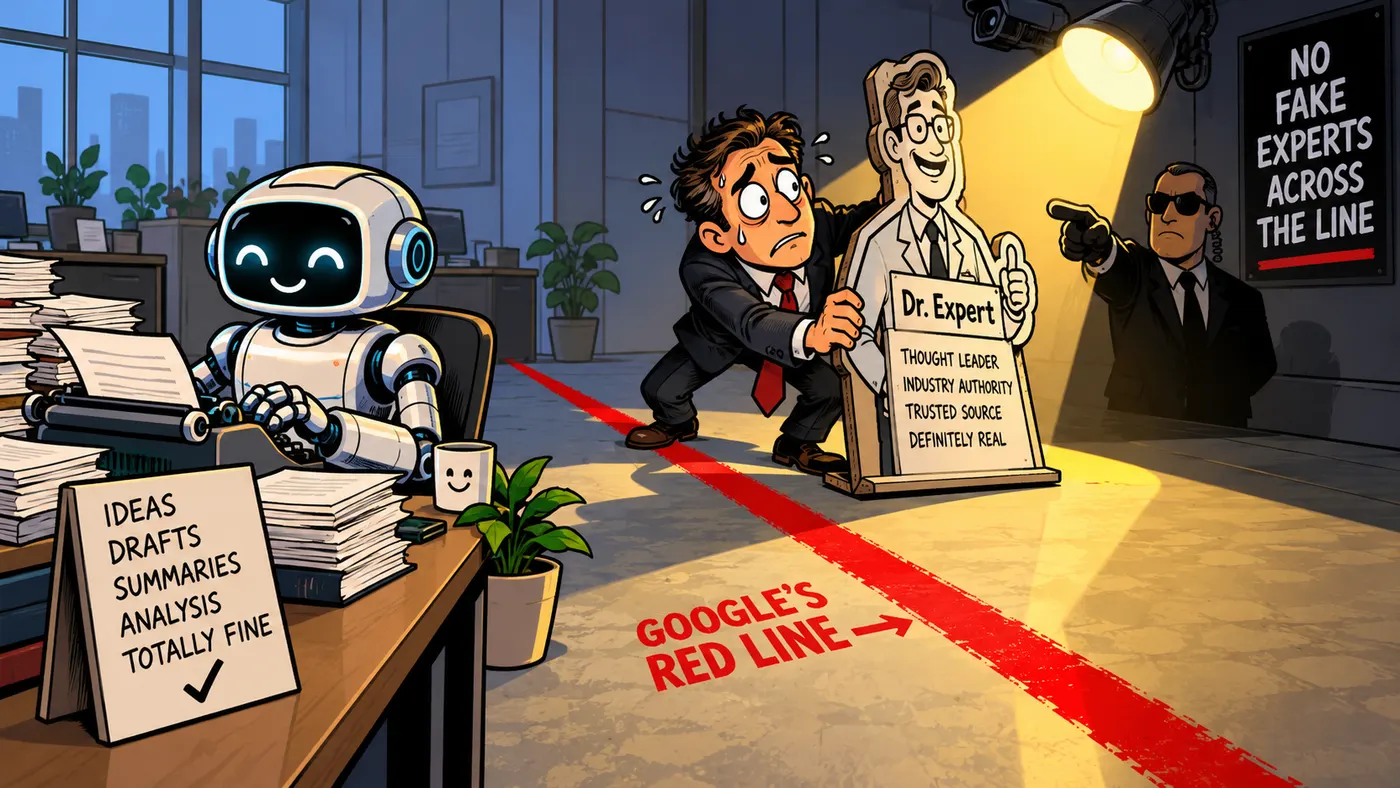
It would be easy to read this story as proof that “Google punishes AI-generated content.”
The available evidence does not support such a simple conclusion.
Google has not publicly said which specific violation triggered which action against Brown Brothers Media.
And the network was not merely using AI.
It was also producing low-value content at scale, publishing fabricated narratives, operating with questionable sourcing practices and presenting fake expert profiles as real people.
Still, the timing is striking.
On October 1, shortly after the network’s visibility collapsed, Google added a remarkably explicit paragraph to its guidance for site owners.
The new language describes the use of AI-generated profile photos, fabricated names and invented credentials to make content appear as though it was written by real human experts as a form of deception.
Similar examples had already appeared in Google’s documentation for quality raters, so this was not an entirely new policy.
What changed was how clearly that principle was brought into the guidance read by publishers themselves.
The safest conclusion is therefore not that Google objects to machines producing text.
The clearer red line is the fabrication of people and expertise in order to make machine-generated content appear more trustworthy than it really is.
An editor who investigated a similar fake-journalist case in Canada reached much the same conclusion: AI may accelerate the fire, but the fire itself is deception.
The Trap of Scale

The irony of the Brown Brothers model is that the same thing that made it successful also helped destroy it.
AI made it possible for a small number of people to keep a dozen publications filled with content at the same time.
But for that volume of content to appear trustworthy, readers had to believe that experts stood behind it.
Maintaining that scale with a real team of specialists would have been much slower and far more expensive.
So Brown Brothers scaled the appearance of expertise too.
Credibility, in a sense, could be purchased.
The name, history and search authority of an established publication could change hands along with the company that owned it.
But that purchased credibility could also be burned through remarkably quickly by the content built on top of it.
Space Daily had spent more than 30 years building its reputation.
A few months were enough to spend part of that reputation under the byline of a NASA engineer who did not exist.
The company now publishes guidelines saying that it uses AI “responsibly” under human editorial oversight.
Taken on its own, that is a perfectly reasonable principle.
Brown Brothers Media’s problem is that it only committed the principle to writing after it had already been caught violating the spirit of it.