The Definition of a Second Is Preparing to Change, but No Clock Will Notice
The second has been defined using the cesium atom since 1967. On October 13, an international conference in Versailles will begin charting the path toward what could replace it. On the same table: the end of the leap second and a common time scale for the Moon.
A second is a second. Or at least that is how we tend to think about it.
But the second we use today has a formal scientific definition, and that definition is tied to an atom: a specific transition frequency of the cesium-133 atom is fixed at exactly 9,192,631,770 hertz.
In everyday terms, one second is the amount of time it takes that radiation to oscillate 9,192,631,770 times.
This atomic foundation was first adopted in 1967, while its official wording in the modern SI system was updated in 2019. For more than half a century, it has underpinned everything from ordinary clocks to GPS satellites and internet timestamps.
Now, after all that time, the foundation is preparing to change.
The reason is simple: the best optical clocks have already surpassed the accuracy limits of cesium.
October 13–15, Versailles
The General Conference on Weights and Measures, or CGPM, the highest international decision-making body for measurement units, will hold its 28th meeting in Versailles from October 13 to 15, 2026.
The conference meets every four to six years and is where the formal definitions of units such as the kilogram, metre and second are decided.
The 2019 redefinition of the kilogram — which freed it from dependence on a physical metal cylinder stored near Paris and instead tied it to a fundamental constant of nature — came through the same process.
This year, three draft resolutions related to time are on the agenda, all scheduled for a vote on the final day:
- The future definition of the second
- The continuity of Coordinated Universal Time (UTC) — in other words, the fate of the leap second
- An international reference time scale for the Moon
For anyone even mildly obsessed with timekeeping, it is shaping up to be one of the most interesting weeks of the year.
Why Isn’t Cesium Good Enough Anymore?
Atomic clocks work by counting the frequency of radiation associated with specific energy transitions inside atoms.
The higher the frequency of the transition, the more finely time can be divided.
Cesium clocks operate in the microwave region, counting a signal that oscillates roughly nine billion times per second.
The new generation of optical clocks uses atomic transitions at far higher optical frequencies. Here, the number of oscillations rises into the hundreds of trillions per second.
The result is dramatic: the best optical clocks are already around 100 times more accurate than the best cesium clocks.
The criteria set for redefining the second show just how large that gap has become.
Before the second can be redefined, optical clocks must demonstrate performance accurate enough to lose less than one second over roughly 16 billion years.
The universe itself is only about 13.8 billion years old.
The Race Isn’t Over Yet
The difficult question is what exactly should replace cesium.
In 1967, the choice was essentially singular.
Today, it is not.
Laboratories around the world are developing optical clocks based on different atoms and ions, including strontium, ytterbium, aluminium and lutetium. Each has its own strengths.
The latest reminder of how competitive the field has become came from Singapore.
A team at the National University of Singapore reported an uncertainty at the level of 10⁻¹⁹ for a clock based on lutetium-176 ions in a paper published in Nature on September 23.
That makes it the most precise clock reported so far.
In theory, a clock performing at that level would take more than 260 billion years to accumulate an error of one second.
Choosing a single atom as the new standard would effectively leave the others behind.
That is why one of the options under consideration is to define the second not through a single atomic species, but through an ensemble of several optical transition frequencies.
Such a system could allow future, better-performing clocks to contribute without forcing another complete redefinition of the second.
The original roadmap aimed for agreement on the form of the new definition by 2026, with the formal redefinition taking place in 2030.
The draft resolution heading to Versailles shows that the race is not finished.
There is still no final consensus on whether the future second should be based on a single atom or on a group of optical transitions. Some mandatory conditions — such as regular contributions from optical clocks to International Atomic Time — have also not yet been fully met.
The expectation is that the work will continue and that a formal proposal will be brought to the next CGPM meeting in 2030.
So the second will not change in Versailles.
But the path toward changing it will be drawn there.
No One Will Notice

Here is the strangest part of the story:
When the second is eventually redefined, no wristwatch, phone or kitchen clock will suddenly behave differently.
The new definition will be calibrated so that the duration of one second remains the same as before.
What changes is not the length of the second, but how precisely we can realize and measure it.
So why go through all this trouble?
Because large parts of the modern world depend on timing differences far smaller than a billionth of a second.
The position shown on your phone depends on precisely synchronized clocks aboard GPS satellites.
Financial markets use timestamps measured in microseconds to establish the order of transactions.
Internet infrastructure and security systems also depend on clocks staying closely synchronized.
Optical clocks are so sensitive that they can measure something else as well:
gravity.
According to Einstein’s general theory of relativity, time passes more slowly in stronger gravitational fields.
The best optical clocks are now sensitive enough to detect the difference in the passage of time caused by a height difference of roughly one centimetre.
A clock, in other words, is becoming a kind of altitude sensor.
Goodbye to the Leap Second
The second draft resolution in Versailles is more concrete than the future definition of the second — and much closer to everyday technology.
Earth does not rotate at a perfectly constant rate. Sometimes it slows slightly; sometimes it speeds up.
Whenever the difference between atomic time and Earth’s rotation becomes too large, an extra leap second has occasionally been inserted since 1972.
For software engineers, these adjustments are a nightmare.
That rare moment when a minute lasts 61 seconds has caused servers and online services to fail in the past.
Under today’s rules, UTC is not allowed to drift more than 0.9 seconds away from time based on Earth’s rotation.
The draft resolution would increase that limit to a full hour — 3,600 seconds.
In other words, leap seconds would not technically be banned.
Instead, the allowed difference would become so large that they would effectively no longer be needed.
If the resolution passes, continuous UTC would begin on May 20, 2027, and according to the international metrology community, the new arrangement could continue for several centuries without requiring another leap second.
The Moon Needs Its Own Clock
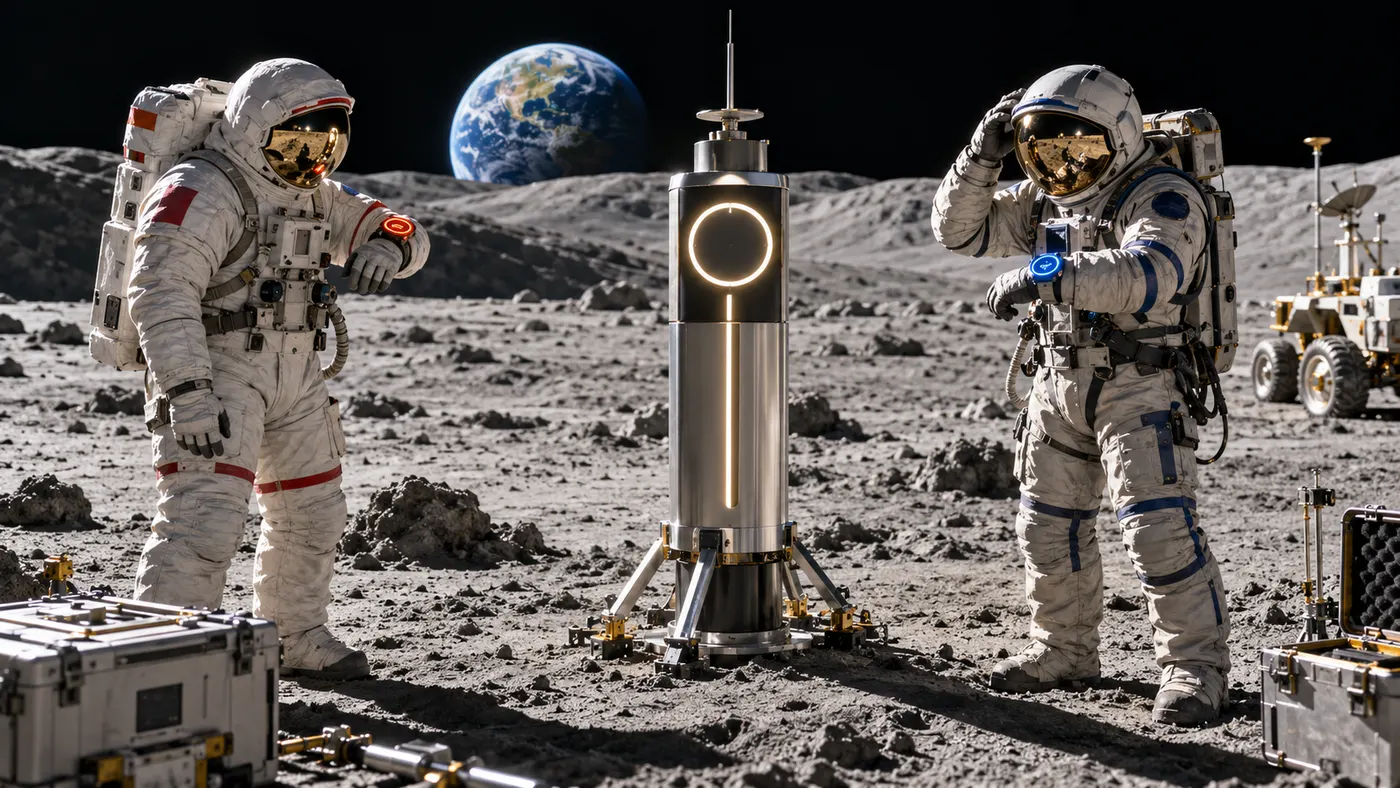
The third draft resolution sounds like science fiction, but the problem is entirely practical.
Relativity matters here too.
Because gravity is weaker on the Moon, a clock on the lunar surface runs, on average, about 56 microseconds per day faster than a clock on Earth.
That sounds trivial.
But for spacecraft attempting to land on the Moon, navigate across its surface or communicate with one another, that difference becomes unacceptable.
A shared time scale is needed so that every country and mission does not simply bring its own version of “what time it is” to the Moon.
The draft resolution does not establish that lunar time scale yet.
Instead, building on Lunar Coordinate Time, defined by the International Astronomical Union in 2024, it starts the process of determining how a common lunar time scale should work and how it should remain linked to UTC on Earth.
For the first time, the question “What time is it on the Moon?” is being discussed at this level of international standardization.
So when delegates gather in Versailles on October 13, they will spend the same week discussing the future of the second, how Earth should keep time, and how time should be measured on the Moon.
The second will not change this time.
But for the first time, the shape of its next definition is coming clearly into view.