
The Witcher 3 Remastered's Strangest PC Problem: Geralt's Hair
One of the highest-rated games of the year stumbled on PC the day after launch, and one culprit was the HairWorks tech behind Geralt's white hair. Strangest of all, turning on a much heavier graphics option made the problem disappear.
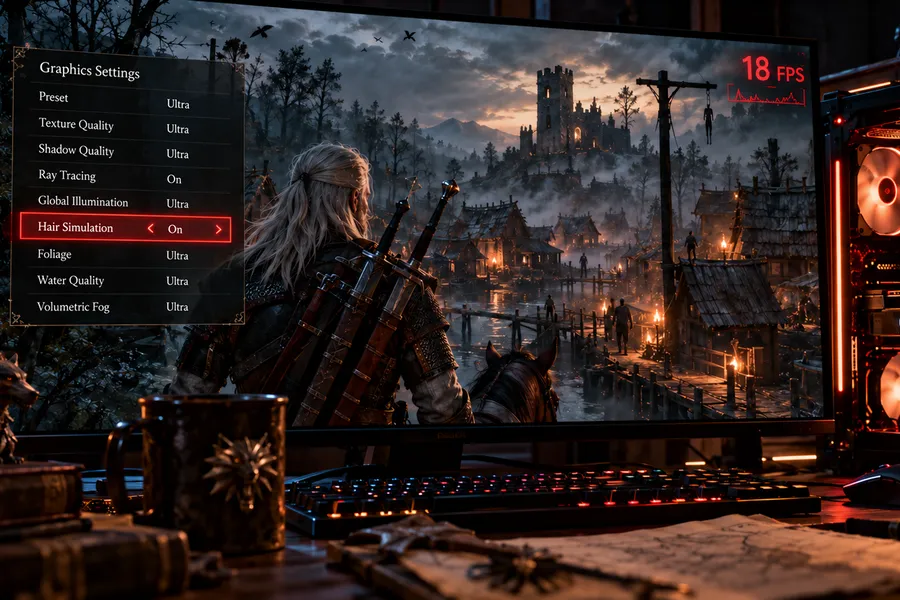
The Witcher 3: Wild Hunt Remastered launched on September 29 as a free update for PC, PS5, Xbox Series X|S and Switch 2.
It got off to a strong start. On PC, the game reached a Metacritic score of 94, placing it at the top of 2026's highest-rated releases, while Steam recorded 120,975 concurrent players — the game's all-time peak.
But some PC players quickly began reporting severe frame-rate drops, visual glitches and crashes.
A day later, on September 30, CD Projekt Red's support account pointed to one of the causes: NVIDIA HairWorks.
The studio said the setting could have a significant impact on performance and recommended disabling it until a patch arrived.
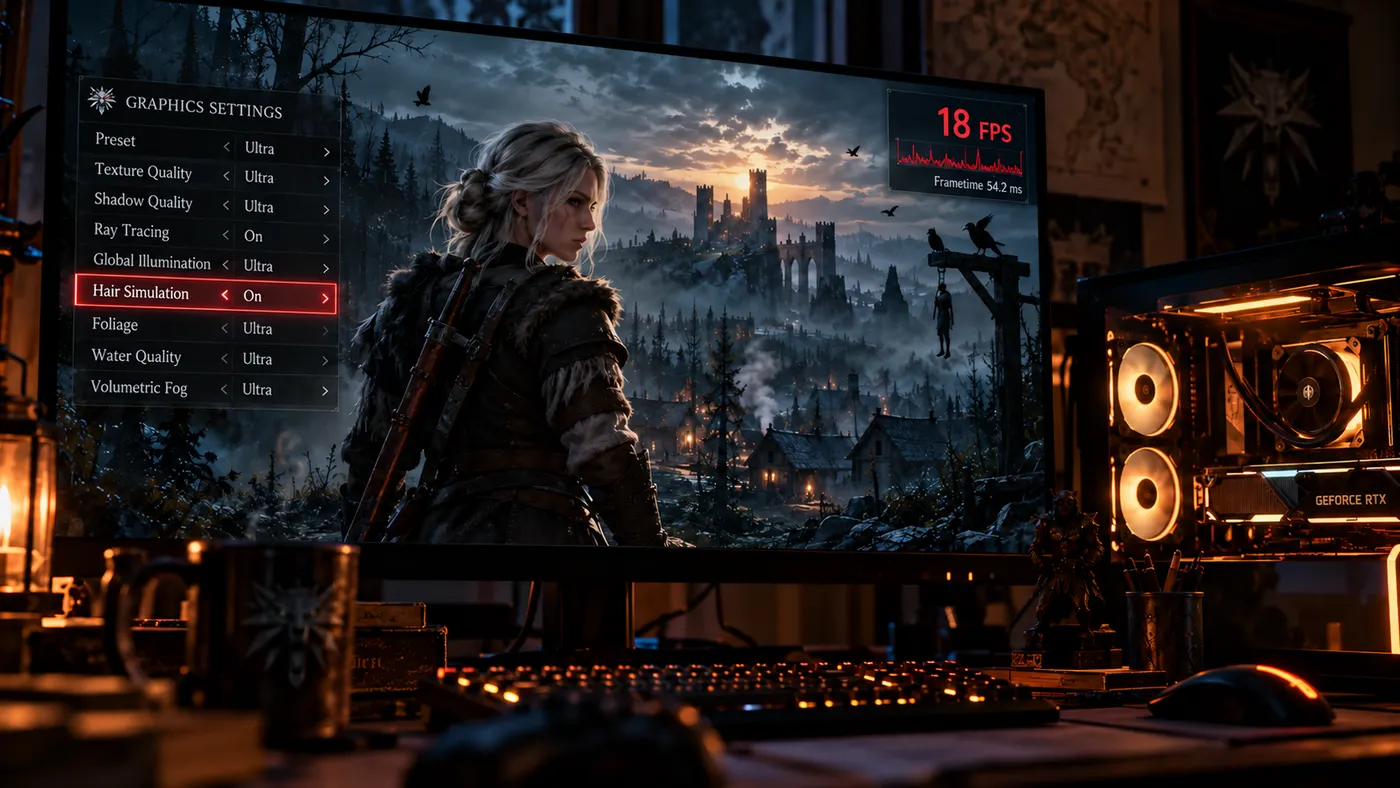
HairWorks is the graphics technology used to simulate Geralt's hair and the fur on creatures strand by strand.
So one of the things making the newly updated game stumble on PC was, quite literally, Geralt's hair.
Why Is Hair So Expensive?
It sounds funny, but hair is one of the hardest things to render convincingly in games.
The easiest way to understand why is to compare it with the rest of a character.
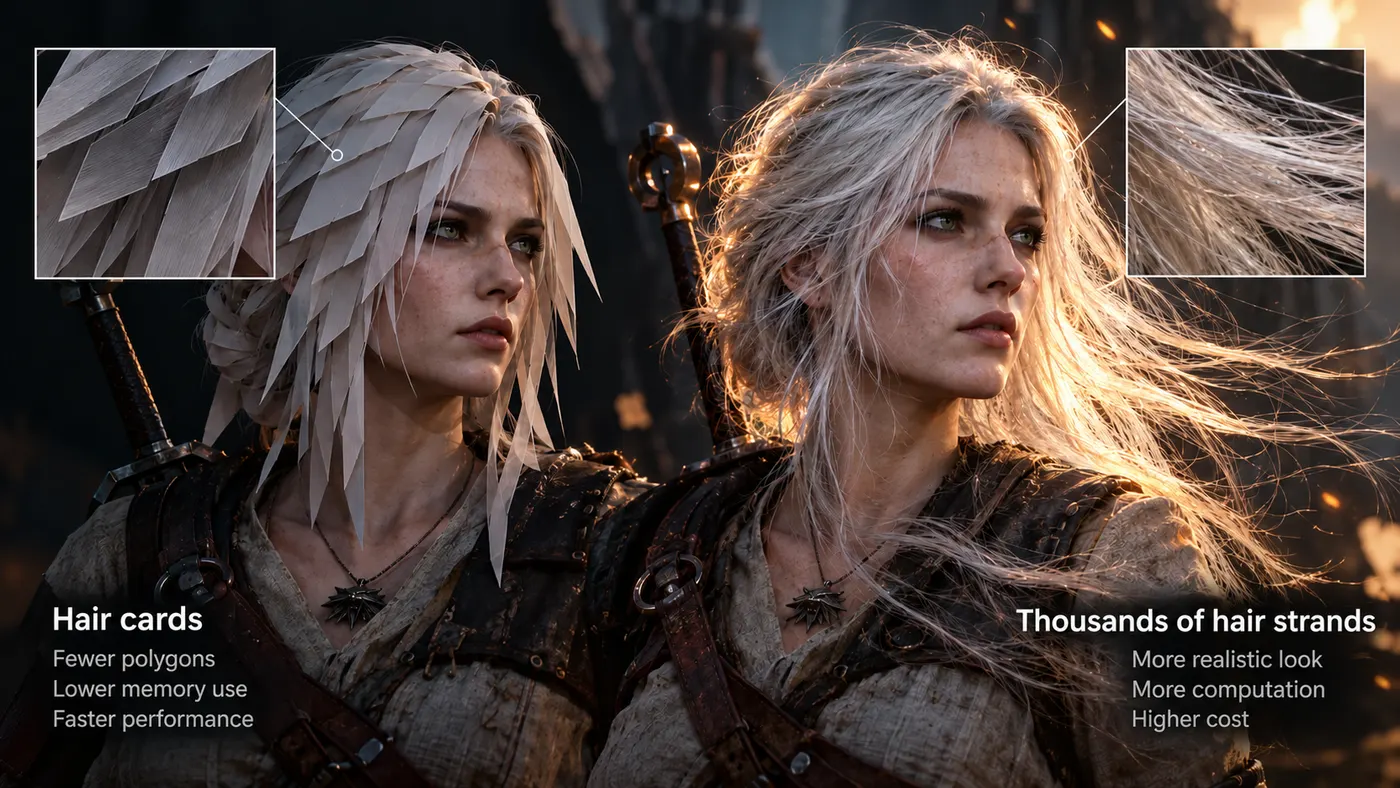
Armor or a face is generally a solid model made from connected surfaces. Most games still fake hair in a similar way, using a handful of flat surfaces covered with hair textures.
From a distance, it can look convincing.
Up close, it looks flat.
HairWorks takes a more ambitious approach.
According to NVIDIA's own documentation, The Witcher 3 uses the technology to render hair and fur with tens of thousands of fine strands rather than a few flat surfaces. In close-ups of Geralt, that number can climb as high as 115,000 strands.
The movement of those strands has to be calculated every frame, along with their interaction with light, the shadows they cast on one another and the fine edges that need to remain smooth on screen.
Each of those extra calculations adds to the GPU workload.
And if hair is not rendered convincingly, it quickly starts looking like either a solid helmet or a plastic wig.
This Isn't the First Time
Geralt's hair causing a performance debate is actually a repeat of history.
HairWorks was already one of the most talked-about and demanding graphics settings when The Witcher 3 first launched in 2015.
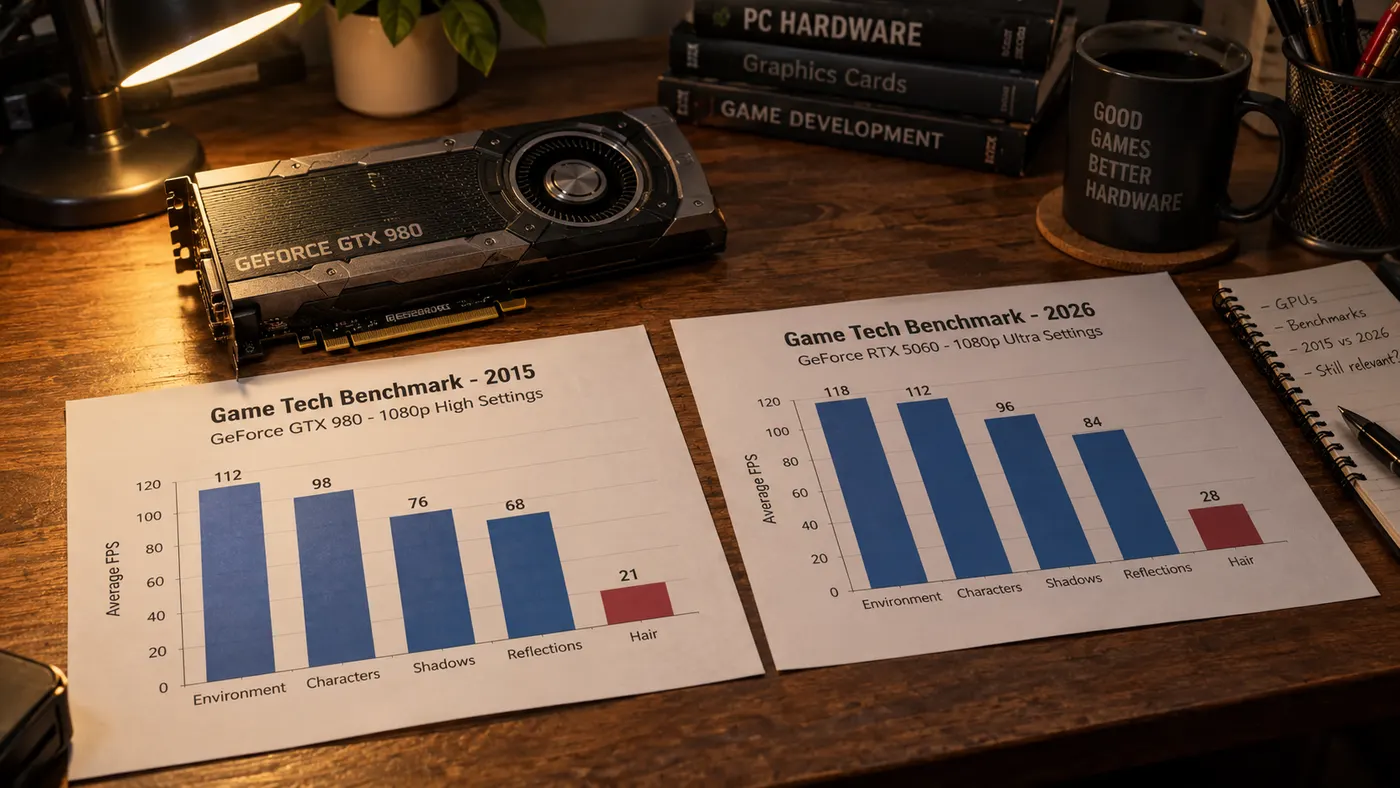
In Digital Foundry's testing at the time, enabling HairWorks caused roughly a 24 percent performance drop on a GTX 970 and around a 47 percent drop on a Radeon R9 290X.
One of the major reasons for that difference was HairWorks' heavy use of tessellation — a process that subdivides surfaces into much smaller pieces to create additional geometric detail.
CD Projekt Red later added more granular controls for hair quality through patches.
Eleven years later, the same hair is causing trouble again in a version of the game built around a new lighting system.
This time, performance is not the only issue.
With HairWorks enabled alongside the new lighting and ray-tracing systems, Geralt's hair has been reported to shine unnaturally, at times looking almost plastic.
Some players have also reported crashes with the setting enabled.
A Heavier Setting, a Faster Game
This is where the story gets interesting.
PC performance site DSOGaming tested one of the new options in Remastered: path-traced hair.
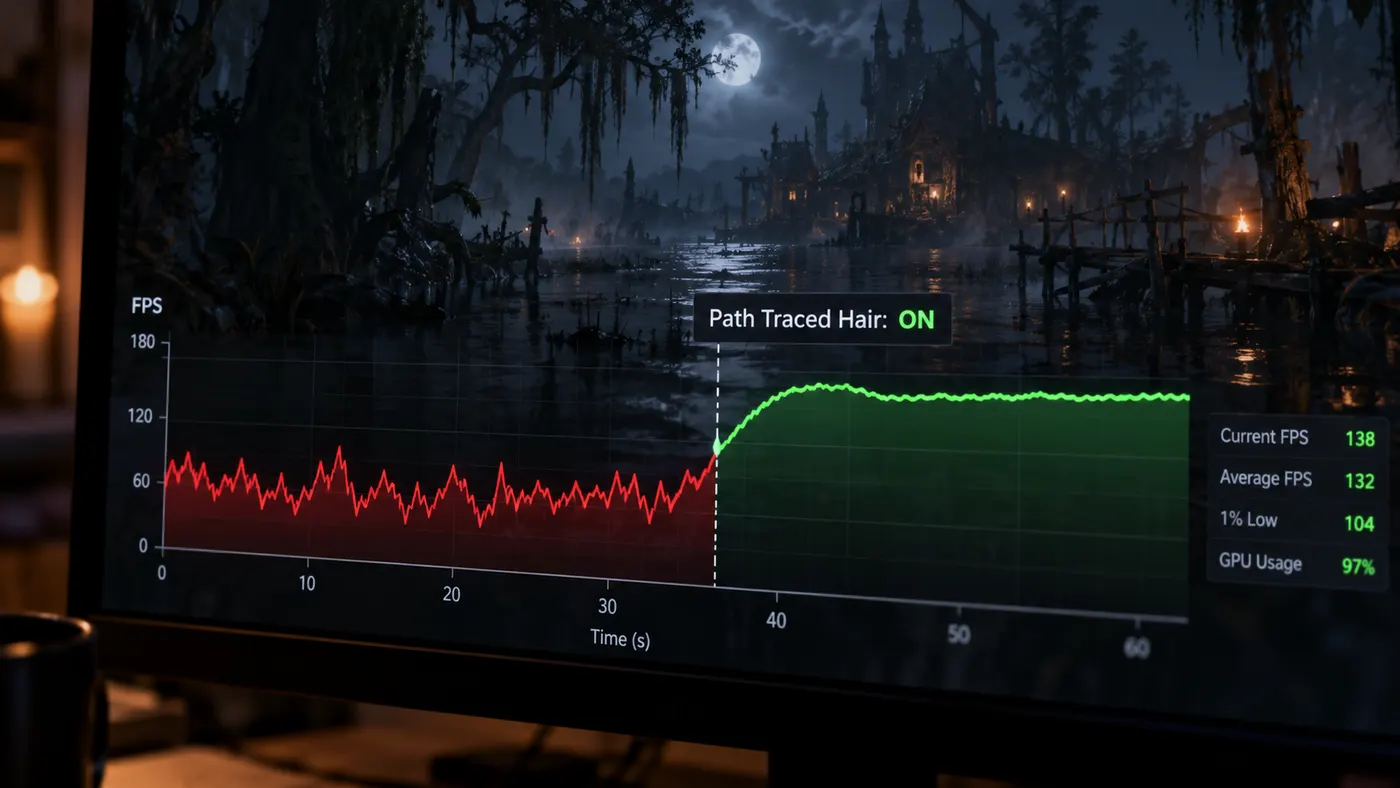
Path tracing is one of the most computationally expensive graphics techniques used in modern games. It simulates the way light travels and bounces through a scene far more realistically than traditional rendering methods.
Logic would suggest that enabling it should make the game even slower.
In DSOGaming's testing, the opposite happened.
When path tracing was enabled and the separate path-traced hair option was turned on, the game performed better — and the strange plastic appearance caused by HairWorks disappeared as well.
There is an important distinction here.
The comparison is not between the game's general ray-tracing mode and path tracing as a whole.
It is between HairWorks in its current broken state and the separate path-traced hair option available when path tracing is enabled.
So path tracing is not somehow cheaper than HairWorks in general.
It is simply bypassing the current HairWorks problem.
CD Projekt Red has not explained the technical root cause in detail.
But the fact that the same hair can both look better and run faster through a different rendering path suggests that the problem is not simply the number of hair strands.
Instead, it points toward a regression in how HairWorks interacts with the game's updated graphics system.
Two Fixes in One Day
CD Projekt Red moved quickly.
The studio released two hotfixes in a single day.

The notes for update 5.00c, released on October 1, say that a change causing serious performance and visual problems for some users with HairWorks enabled was reverted.
That strengthens the regression theory: the issue appears to have been caused less by the underlying hair technology itself and more by a change introduced alongside the Remastered update.
The other fixes also addressed save-file, audio and visual issues.
The studio additionally recommended updating GPU drivers from NVIDIA, AMD and Intel, noting that newer drivers could help resolve visual glitches and sudden performance drops.
And performance problems are not limited to hair.
Console players have also reported frame-rate issues, and CD Projekt Red says it is continuing to investigate other problems.
Still, Geralt's hair remains the most memorable example, because few things illustrate the strange cost of visual realism in games quite so well.
Eleven years ago, making individual hair strands look convincing was one of the most expensive tricks a graphics card could be asked to perform.
Today, even path tracing — a technique that calculates individual light bounces across an entire scene — has made its way into the game.
And yet a single regression in old HairWorks code can still turn Geralt's hair into a performance problem.
Sometimes that is what progress in graphics technology looks like: not just solving new problems, but making sure solutions from a decade ago still work properly inside entirely new rendering systems.