
He Bought a Used CPU and Got Someone Else's Ban With It
A gamer in Germany bought a used Ryzen CPU and was kicked out of Valorant the moment he launched it. The processor had been linked to its previous owner's cheating, and there is no serial-number lookup that can reveal that history before you buy.
The story began with a post on a German PC hardware forum.
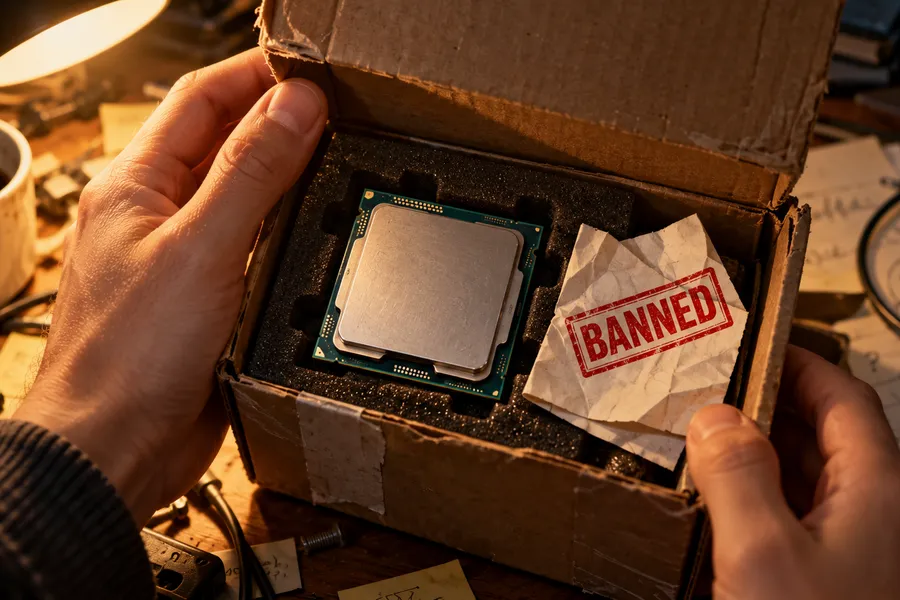
On September 21, a user bought a second-hand AMD Ryzen 7 5800X3D. The processor worked exactly as expected in every respect — until he launched Valorant.
The game immediately kicked him out.
After contacting Riot Games support, he learned something unusual: the processor he had bought had been blacklisted by Vanguard, Riot’s anti-cheat system, on August 12 — five weeks before he ever owned it.
The blacklist was tied to cheating activity by the processor’s previous user.
Support told him the ban could not be removed.
How Does a Hardware Ban Work?

With a traditional account ban, the account used for cheating is shut down.
But for a cheater, creating a new account can take only a few minutes.
That is why major anti-cheat systems go a step further: in addition to the account, they can record hardware identifiers associated with the machine used for cheating.
In what is commonly known as an HWID ban, the system uses hardware identifiers — or a fingerprint built from several of them — to recognize a device.
If hardware associated with a ban appears again, the anti-cheat system can identify it even when a completely different account is being used.
Riot has openly explained that Vanguard uses hardware identification as part of its effort to stop repeat cheaters.
In theory, it makes sense.
It prevents a cheater from simply changing accounts and carrying on as before.
But it depends on one assumption: that the hardware stays with the same person.
The second-hand market breaks that assumption.
If, as in this case, a ban is associated with a particular piece of hardware, selling that hardware can make the punishment appear in front of its next owner instead.
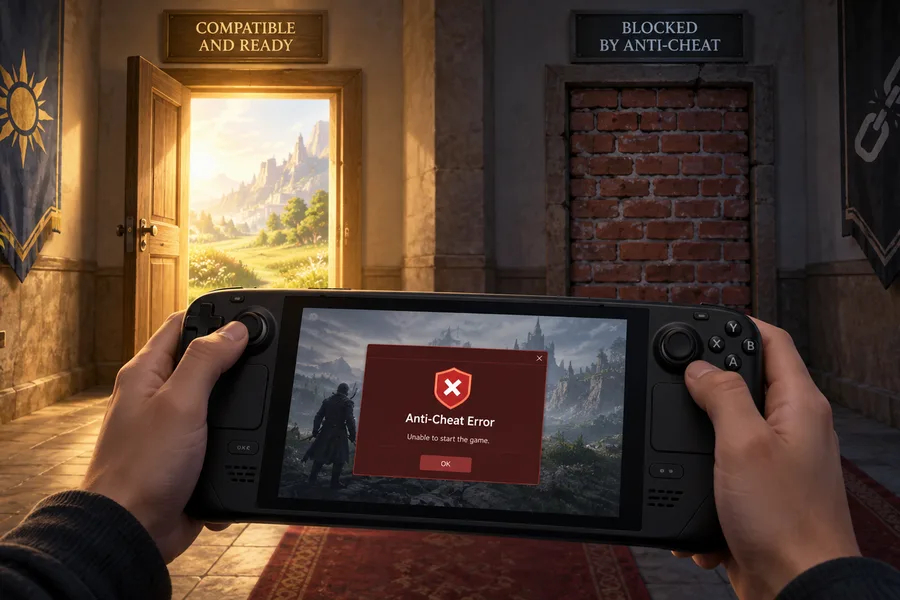
We previously covered another controversial side of anti-cheat systems — why hundreds of multiplayer games still do not work properly on the Steam Deck — in a separate article.
Riot’s Answer: Four Months

As the story spread across social media, Phillip Koskinas, one of the people responsible for Riot’s anti-cheat systems, stepped in.
His explanation made the worst interpretation of the situation somewhat less alarming:
- Riot’s hardware bans last no more than four months.
- The bans are game-specific, meaning a Valorant ban does not affect unrelated games.
- Support can tell the user how much time remains on the ban.
Koskinas also pushed back against another claim.
The user who made the original post said that other components in his system had also been blacklisted after the processor was detected.
Koskinas said that when one component matches a ban, the rest of the machine is not automatically added to the denylist, and described that scenario as highly unlikely.
So in this case, the buyer has not lost anything permanently.
If the restriction that began on August 12 lasts all the way to Riot’s four-month maximum, it should expire around mid-December.
But that is Riot’s policy.
Not every company handles hardware bans the same way.
In Other Games, the Consequences Can Be Much Harsher

Riot’s four-month limit makes this particular case temporary.
But the scope and duration of hardware bans vary significantly between companies.
Activision provides a much harsher example.
According to the company’s current Call of Duty security policy, hardware bans can be applied to the device itself, can extend across past, current and future Call of Duty titles, and may last for different lengths of time.
Hardware bans also cannot be appealed.
Activision even explicitly warns people buying second-hand hardware.
Its policy notes that used, shared or publicly accessible devices may still carry an active hardware restriction if they were previously used to violate the rules.
The company’s suggested way to check is to launch Call of Duty on the device using an account in good standing.
In other words, there is no system where you can enter a serial number before buying a part and ask whether it is “clean.”
The check only becomes possible once the hardware is physically in your hands.
So the Ryzen case is not simply a bizarre one-off.
It is a real second-hand risk that game companies themselves acknowledge.
The Real Problem: There Is No Way to Check in Advance

The unsettling part of this story is not the length of the ban.
It is this simple fact:
There is no system that lets you remotely check the ban history of a used component before buying it.
Major anti-cheat systems do not offer a shared service where buyers can check whether a second-hand component is associated with an active restriction.
And there is an obvious reason why such a system would be difficult to provide.
A public lookup tool would also make it much easier for cheaters to learn exactly which parts of their hardware had been flagged.
Asking the seller does not solve much either.
Someone selling hardware after being banned is unlikely to write, “Yes, this component is blacklisted,” in the listing.
Second-hand GPU buyers have lived with a similar kind of uncertainty for years:
Was this graphics card used for cryptocurrency mining at full load for months?
At least in that case, benchmarks, temperature checks and visual inspection can offer clues.
A hardware ban leaves no physical trace.
The component can work perfectly.
It can pass every benchmark.
The problem exists only as an entry on a game company’s server.
Second-hand hardware now has not only a physical condition, but potentially a digital history as well.
So What Can You Do?
There is no foolproof way to protect yourself, but a few habits can reduce the risk:
- Buy from somewhere with a return policy. If the seller or platform offers returns, that may be your only real protection against this kind of surprise.
- Keep it in mind if you mainly play competitive games. If you are building a PC for Valorant, Call of Duty or another title with aggressive anti-cheat systems, remember that a used component may carry an invisible history.
- Contact support if you encounter a ban. As the Riot case shows, some companies can at least tell you how much time remains on a restriction. That helps clarify what you are dealing with.
Anti-cheat systems increasingly treat hardware as a more persistent identity than the person using it.
That makes sense if the goal is to make life harder for repeat cheaters.
But in a world where hardware changes hands, it also creates an unavoidable side effect: eventually, the punishment can reach the wrong person.
The processor itself did not change.
The only thing that changed was that this time, the box came with a history no one told the buyer about.