

Saturn Has Had a Hexagon in the North for 40 Years. Now a Ten-Sided Shape Is Emerging in the South
Scientists spent more than 35 years searching for a southern counterpart to Saturn's giant north-polar hexagon. They finally found one, but it is not a hexagon: it is a ten-sided wave that is becoming clearer before our eyes.
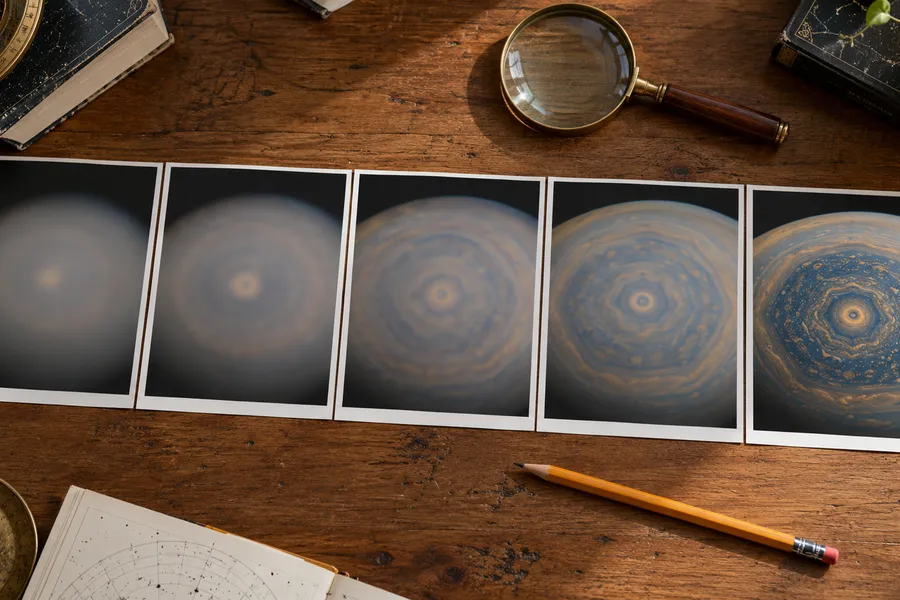
You would not expect to find a straight-edged geometric shape in a planet’s atmosphere. Winds, clouds and storms swirl, curl and disperse; they do not usually have corners. Yet at Saturn’s north pole sits an enormous hexagon whose sides look almost as if they were drawn with a ruler. And this year, the discovery of a similar structure at the opposite end of the planet was announced: a ten-sided “decagon.”
A 40-year-old mystery
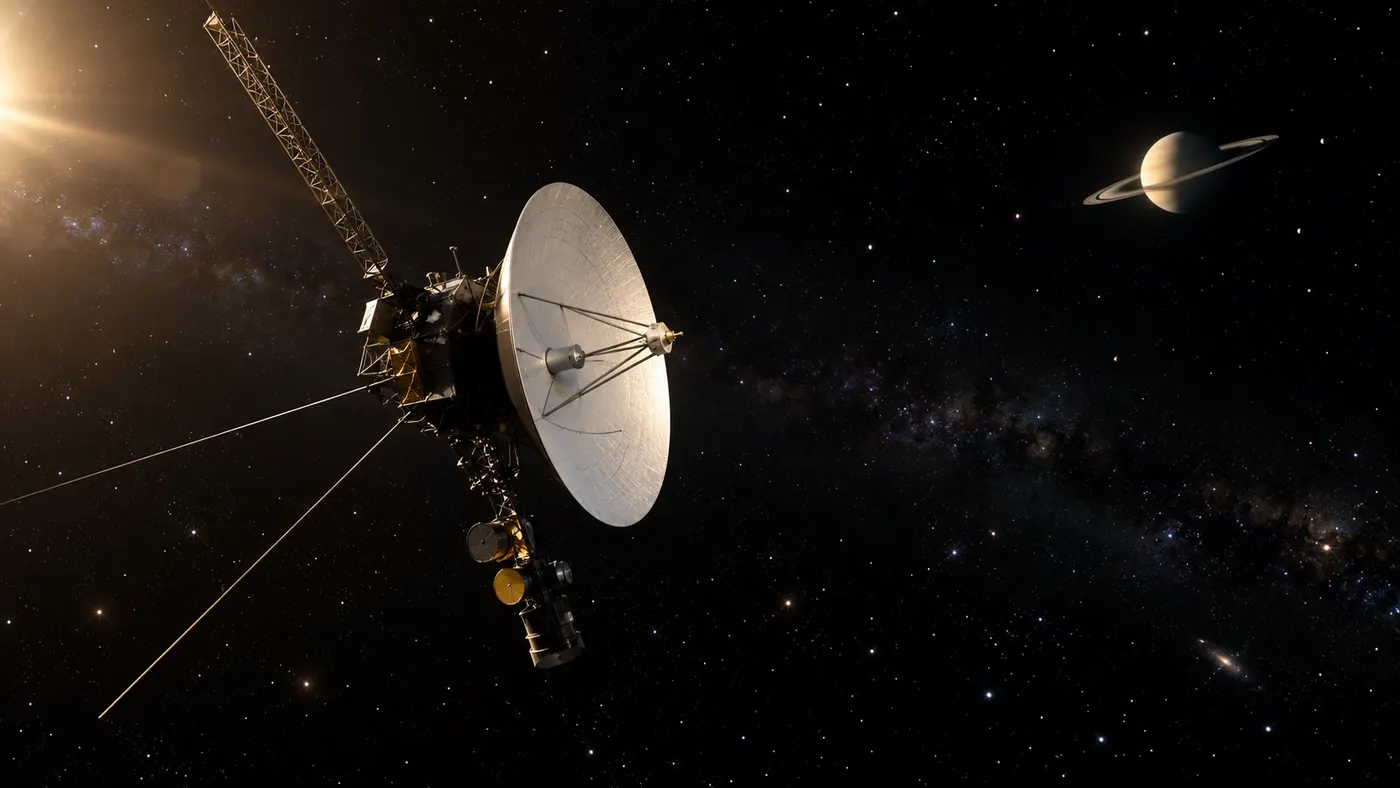
The northern hexagon was first identified in images taken by the Voyager spacecraft in 1980 and 1981. Over the following decades, ground-based telescopes, the Hubble Space Telescope and the Cassini spacecraft, which orbited Saturn from 2004 to 2017, observed it again and again. Every time scientists looked, the hexagon was still there, preserving its basic geometric structure.
According to the leading explanation today, the hexagon is not a cloud but a wave. A powerful jet stream blows around the pole at roughly 100 meters per second, and the hexagon is a giant atmospheric wave riding on that current while remaining almost stationary relative to Saturn’s rotation. Laboratory experiments with rotating fluids have produced similar polygons ranging from triangles to octagons, but only when differences in flow speed and fluid properties fall within certain limits. In other words, the hexagon is not a coincidence — but neither is it something that forms everywhere.
Because Saturn’s jet-stream systems in the two hemispheres are broadly similar, scientists naturally asked another question: is there a hexagon at the south pole too? According to study author Agustín Sánchez-Lavega, the team had been searching Hubble images for a southern counterpart since 1990. Even across Cassini’s 13 years of observations, no such persistent structure had been seen.
The shape emerging in the south
Eventually they found something — but not what they expected.
According to the study published in Science Advances on September 2, the first hints of a ten-sided structure appeared around Saturn’s south pole in red-light images taken by Hubble in October 2023. Amateur astronomers independently noticed the feature in 2024. By August and September 2025, Hubble images showed all ten corners of the decagon clearly.
The structure can be traced across a broad atmospheric belt spanning roughly 53 to 66 degrees south latitude, extending about 13,000 kilometers from north to south. The characteristic distance between two neighboring corners is around 16,800 kilometers — larger than Earth’s diameter. Like the northern hexagon, it is visible not just at the upper cloud level but across multiple layers of the atmosphere. This is not merely a surface pattern; it is a vertically extended structure.
It is not the same — and we are watching it take shape
The most important difference between the decagon and the hexagon is that the decagon is changing.
According to Amy Simon, principal investigator of Hubble’s Outer Planet Atmospheres Legacy, or OPAL, program, the northern hexagon has been there every time scientists have looked for more than 40 years. The decagon is different: it appears to be strengthening, giving researchers a rare opportunity to watch a giant atmospheric pattern develop in real time. Corners that were faint in 2023 became increasingly clear in 2024 and 2025.
There is another difference. While the northern hexagon remains almost stationary relative to Saturn’s rotation, the southern decagon drifts eastward at roughly 2.5 meters per second. What makes that especially interesting is that the jet stream containing it blows at about 116 meters per second. In other words, the air moves dozens of times faster than the pattern itself. The decagon is not simply being carried along by the wind passing through it; it moves at its own pace.
That is not something astronomy often gets to watch. Large planetary structures are usually either already there or appear and disappear relatively quickly. Being able to follow a structure gradually becoming more distinct over several years is a rare opportunity. And much of that opportunity exists because of Hubble’s longevity: instead of a single snapshot, astronomers have a time series stretching across years.
Why ten sides, and why now?
There is no definitive answer to either question yet — and that is what makes this part of the story especially interesting.

The number of sides produced by a wave riding on a jet stream depends on factors such as the speed of the current, its latitude and the properties of the atmosphere. The northern hexagon sits at about 78 degrees north, while the southern decagon lies at a much lower southern latitude, suggesting that the two waves formed under different conditions. The study also points to a large anticyclonic vortex just north of the decagon, although it is not yet clear whether the two are connected.
The answer to “why now?” is even less certain than it might seem. Cassini observed no such structure before its mission ended in 2017, while Hubble detected it in data from 2023. In between was a period when Saturn’s south pole was not well positioned for observation from Earth. The decagon may therefore have formed sometime during this 2017–2023 observational gap, but we do not know exactly when it appeared.
Saturn’s seasons each last roughly seven Earth years, and the amount of sunlight reaching its southern hemisphere changes substantially over that time. It is possible that these seasonal changes are related to the decagon’s emergence, but the study does not establish a cause-and-effect relationship. For now, it remains only one hypothesis to test.
These are good days to look at Saturn
You will not be able to see the decagon with your own eyes; resolving that level of detail requires a telescope like Hubble. But this is a very good time to see Saturn itself. Saturn reached opposition on October 4, meaning Earth passed directly between the Sun and Saturn. As a result, the planet is currently in one of its brightest and most favorable observing periods of the year. Even a small telescope can reveal its rings.

When you look at that bright point in the sky, knowing that a hexagon has remained at the north pole for more than 40 years while a ten-sided wave in the south slowly drifts along and becomes clearer year by year makes one of the most familiar planets in the night sky feel a little stranger — and a little more alive.
TagsSpace