
James Webb Spots a Possible Supernova from 12.5 Billion Years Ago: Why Does It Appear to Unfold Six Times More Slowly?
James Webb caught the light of what may be a stellar explosion from 1.2 billion years after the Big Bang at a very early stage. Because the universe has expanded, it reaches us six times more slowly; why that happens and why the discovery matters.
What Did Webb See?
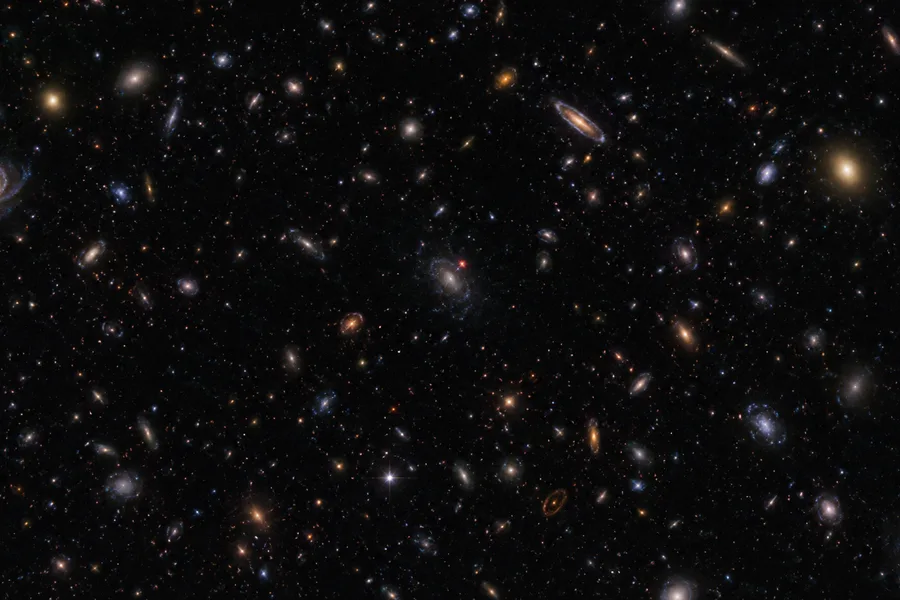
The object, named AT 2026abck, lies in a distant galaxy where stars are forming rapidly. Its light has traveled for more than 12.5 billion years to reach us. In other words, we are seeing it as it was when the universe was less than one-tenth of its present age. Galaxies were growing quickly during that era, and new stars were forming at an intense rate.
Webb detected no sign of an explosion in this region during its observation on May 28, 2026. But on August 7, a new source of light appeared in the same area. Based on the object's properties, researchers estimated that the explosion may have occurred roughly four to ten days earlier in the source's own frame of reference. Webb therefore likely caught a stellar explosion at a very early stage. That age, however, is an estimate derived from scientific modeling, not a direct measurement.
There is another important caveat: The "AT" prefix is used for astronomical transients that have not yet been definitively classified. A supernova is the leading explanation for AT 2026abck, but its nature has not been conclusively established.
71 Days or 12 Days?
Here is the most striking part of the discovery. Seventy-one days passed on Earth between Webb's two observations. In the exploding star's own frame of reference, however, that interval corresponds to only about 12 days.
The reason is the expansion of the universe. Since the light left this distant galaxy, the universe has expanded by a factor of roughly six. As the light traveled through expanding space, its wavelengths were stretched by the same factor. This shifted the light toward the red end of the spectrum and beyond, into infrared wavelengths invisible to our eyes.
But the stretching affects more than color. It also changes the timing of the signals we receive. Light emitted at successive moments reaches us with the intervals between those moments stretched by a factor of six.
As researcher Ming-Yang Zhuang explained to Live Science, the universe has expanded since this light was emitted, making the explosion appear to unfold in slow motion, about six times more slowly than it actually did. A change that took one week at the star would take about six weeks to play out from our point of view.
Imagine drawing equally spaced dots along a rubber band and then stretching it. As the band gets longer, the gaps between the dots grow. Something similar happens to the "ticks" of light arriving from a distant star: If successive signals were emitted one day apart, the expansion of the universe can stretch the interval between their arrival times to six days.

This effect is called cosmological time dilation, and it offers astronomers an opportunity. The earliest stages of an explosion that would normally last only a few days are spread over weeks from our perspective, giving telescopes more time to catch them. The initial published analysis of AT 2026abck is based on the May 28 non-detection and the August 7 discovery observation. Further observations are needed to determine how the explosion evolved afterward.
Why Does It Matter?
Stellar explosions from the universe's first few billion years offer a direct window into how massive stars of that era lived and died. Those stars formed in environments very different from today's. Heavy elements—what astronomers call "metals," including carbon, oxygen, and iron—were much less abundant. Many of these elements were dispersed into space by stellar explosions, providing raw materials for later generations of stars and planets. In that sense, such explosions are part of our own origin story.
Observing them is extremely difficult, however. Their light is faint, and the expansion of the universe has shifted much of it into the infrared. Webb's infrared-optimized telescope and instruments make it possible to detect an outburst at such an extraordinary distance.
Another remarkable aspect of this discovery is that it did not depend on gravitational lensing. Light from very distant stellar explosions is often magnified by the gravity of massive galaxy clusters along our line of sight. The light from SN Eos, for example, was magnified dozens of times by a foreground galaxy cluster. AT 2026abck was detected without such a natural magnifying glass. This suggests that Webb could discover more stellar explosions in the early universe simply by revisiting the same regions of sky at regular intervals.
Brighter Than Expected
AT 2026abck has another property that surprised researchers. Modeling its brightness at different wavelengths suggests a temperature of around 17,000 kelvin. Its luminosity is also considerably higher than that of typical, well-studied supernovae in the nearby universe at comparable early stages.
According to Universe Magazine, none of the dozens of comparable nearby supernovae studied exceeded 15,000 kelvin six days after the explosion or reached such high luminosity by day four. Some reports have suggested that AT 2026abck could be a superluminous supernova, but that classification remains unconfirmed.
The difference may offer a clue that stars and explosions in the early universe behaved differently from those we see nearby today. Still, it is too early to draw firm conclusions from a single detection epoch. Astronomers hope that follow-up observations will show how AT 2026abck changes and fades over time, helping them determine what kind of event they have found.
Is It the Most Distant Supernova?
News reports often describe AT 2026abck as one of the earliest supernovae ever observed, and that cautious wording matters. Webb has already detected other stellar explosions at comparable distances. SN Eos, for example, is among the most distant spectroscopically confirmed supernovae and dates to a time when the universe was approximately 1.1 billion years old.
What makes AT 2026abck special is not simply its distance. It is the possibility that Webb caught the explosion so early, when any subsequent changes would appear stretched out by cosmological time dilation.
Every star we see in the night sky is, in a sense, a letter from the past. AT 2026abck is a letter sent 12.5 billion years ago whose final lines may still be reaching us. Astronomers can read those lines at a pace six times slower than events unfolded at the star itself.
TagsSpace